Fair means the same rules, role-adjusted, with the evidence underneath.
A single number cannot capture a human being. It can force a method into the open. If you disagree with a rating, you should be able to see which pillar moved it and what fact would change it.
The whole journey on one page
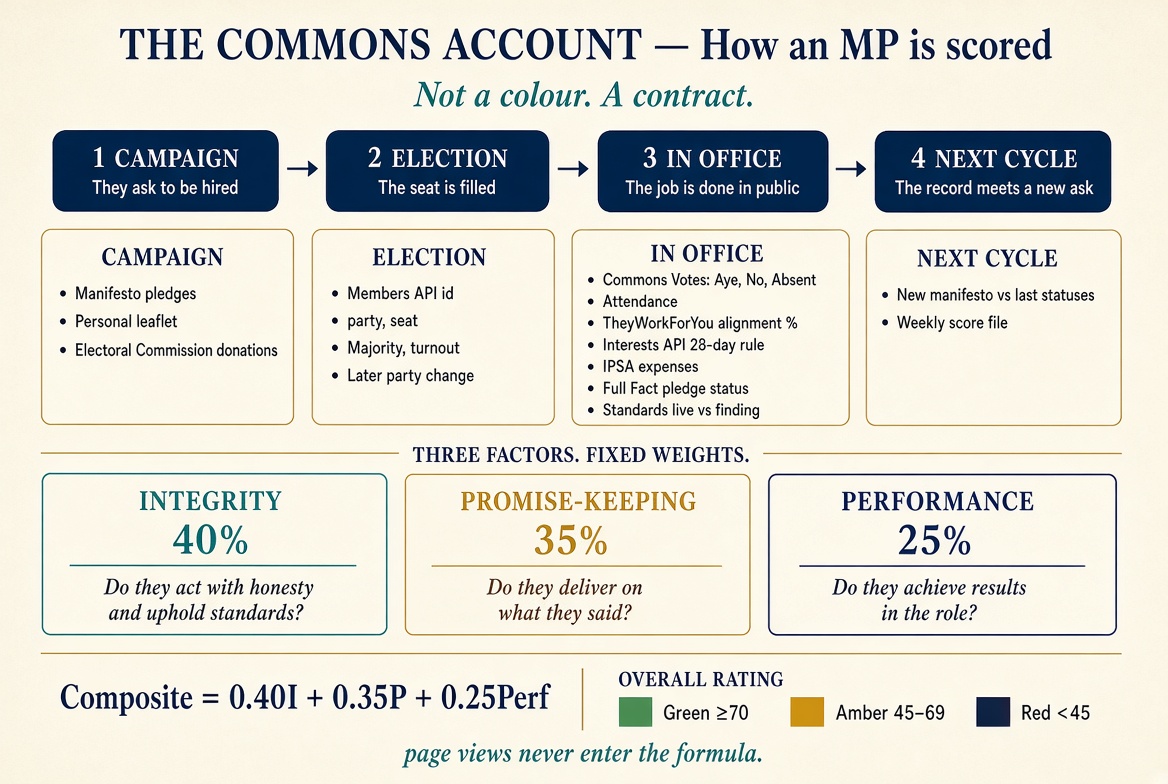
Read top to bottom. An MP’s working life is four stages. Under each stage are the exact public fields we take. Those fields are then sorted into three pillars. The output is three scores, one composite, a colour, and a weekly line — never a vibe.
1 · CampaignThey ask to be hired
2 · ElectionThe seat is filled
3 · In officeThe job is done in public
4 · Next cycleThe record meets a new ask
same person · same seat · new evidence each week →
What we take from the campaign
Party manifesto: numbered pledges they stood on
Personal prospectus / leaflet: local claims in their name
Electoral Commission: donations to the local party or regulated donee, donor name, amount, date
What we take from the result
Parliament Members API: member ID, party on election night, constituency, start date
Commons Library result: votes, majority, turnout
Later party change (e.g. Reform → Restore) as a new contract, not a silent rewrite
What we take while they sit
Commons Votes API / Hansard divisions: date, motion title, Aye / No / Tell / Absent
Eligible divisions vs divisions voted — attendance rate
TheyWorkForYou: party-alignment % by year, rebellion count, policy-cluster direction
Interests API: category, amount, donor, date received, date registered (28-day test), rectifications
Electoral Commission PEF (Political Finance database): gifts not only on the Commons Register
Independent Parliamentary Standards Authority (IPSA): personal expense category and amount (kept separate from departmental travel)
GOV.UK cabinet lists: role, start and end dates
Full Fact tracker: pledge ID, owner, status (Achieved / On track / In progress / Off track / Not kept / Unclear)
Commissioner for Standards / Independent Complaints and Grievance Scheme (ICGS): live inquiry vs completed finding vs no finding
A public statement — Hansard quote or official post — only if it is a claim that can collide with a vote, a Register row or a pledge. Likes are discarded.
What we take at the next election
New manifesto vs the last term’s pledge statuses
Whether they stood again, and under which label
The weekly score file for that parliament (not rewritten except via changelog)
How those fields are sorted
Integrity · 40% Register timing and completeness; donation or hospitality overlapping a vote in the same window; speech or official post vs the division list; live inquiry flagged as live; completed finding scored as a finding. Rebellion helps only if it matches their own prior claim.
Promise-keeping · 35% Manifesto and personal pledges they own. Ministers inherit the brief they front. Opposition inherits their platform, not housing starts. Full Fact status mapped to a 0–100 band. Unclear holds the last score; it does not invent a mid-amber.
Performance · 25% Attendance vs peers in the same role; the brief they actually hold; time in post (six weeks as chancellor is not scored as a full-term Budget). Committees and questions count; fame does not.
One-page poster of the same framework. The lists above are the full field list.
Three pillars
Integrity · 40%
Do words, votes and money point the same way? Late or missing declarations, standards findings, and speech-versus-vote contradictions sit here. Rebellion is not automatically honest. Whip loyalty is not automatically corrupt.
Promise-keeping · 35%
Did they keep what they asked to be judged on? Ministers carry delivery of the programme they front. Opposition MPs carry consistency of their own platform. Backbenchers are not failed prime ministers.
Performance · 25%
Did they show up and do the job that exists — divisions, questions, the brief they hold? Outside earnings plus low attendance is a cleaner flag than raw expenses on a distant seat.
How the composite is made
Each pillar is scored 0–100 from a structured evidence pass. The composite is a weighted average:
The three pillar colours are always shown. A minister who hits a target and hides an interest can be green on delivery and red on integrity. Compressing that into one unexplained tile is how these tools become propaganda.
Role adjustment — the rule that stops a rigged comparison
A Home Secretary can be judged on hotels, returns and the bill they are taking through the House. A Liberal Democrat leader cannot. A newly arrived backbencher cannot be blamed for national housing starts. If you skip this step, you either punish the opposition for not running the country or excuse the government because “it’s complicated.” Both are unfair.
Backbench rebels are scored against the claim they made to their own voters, not against a whipped paragraph they publicly rejected. That is why Richard Burgon can outscore a prime minister on this pilot without the site endorsing his programme.
Local schemes — the missing pipe
A Member of Parliament is hired for a place, not only for a division lobby. The first pilot file was Westminster-heavy: votes, the Register, the national tracker. That missed Peak Cluster in Wirral West — a named corridor through green belt, a council oppose-the-route motion, a petition, and a collision with the member’s own 2024 brownfield-first sentence.
From this pass every pilot card has a local-scheme row. The rule is the same for every colour of rosette:
Name the scheme (Nationally Significant Infrastructure Project, green-belt release, major plant, closure).
Match it to the member’s own published local pledge, not to the campaigners’ science.
Use council minutes, Planning Inspectorate registrations, parliamentary petitions, dated official posts and Hansard. Not Facebook likes.
Promises can move by up to −10 until there is an on-record outcome. Performance can move −6 to +6 for what they put on the record.
Integrity moves only if a dated public claim about the scheme is false and left uncorrected.
The site does not decide whether carbon capture, solar or a clean-air zone is good technology.
Where the sweep found no NSIP-scale collision, the card says so. Silence is a result, not a hidden amber.
Surgeries and casework — why they are not in the score
Members hold surgeries. Constituents bring housing, benefits, immigration and hospital waits. How many of those files are opened, and how many are actually resolved, would be the most human measure of “fighting their corner”.
That file is not published. It is personal data. IPSA publishes office and staffing costs, not outcomes. Parliament does not release a solved-case register. A number an MP puts on a leaflet (“I helped 16,500 people”) is a self-report. It cannot be checked against a closed-case list, so it is not loaded as Performance.
What can sit on the card instead, and already does where we have it:
Written questions and debates that name the constituency.
Planning Inspectorate registrations and council minutes on a named local scheme.
Petitions broken down by constituency where Parliament publishes them.
An advertised surgery timetable — evidence they turn up, not evidence they solved the case.
If a future parliament published an anonymised casework standard (opened / referred / resolved, no names), it would be wired into Performance with a cap so a busy inner-city seat is not punished against a quiet one. Until that public standard exists, scraping surgeries would break the method and the law.
Readiness — a lens, not a fourth pillar
The composite answers whether the record matches the contract. It does not answer whether the person was prepared for the job they are asking for. Voters ask that question anyway. A second lens can put the public biography in front of them without pretending biography is a grade.
Competencies are taken from what the office actually requires, not from a hall of “successful politicians.” Success in politics is circular: the winners write the definition. The questions that survive a test against the job are narrower.
Work before the whip. What did they do to earn a living, for how long, and at what scale of budget or people? A care worker, a regulator, a shop steward and a barrister are different preparations. None is a bonus for class.
Match to the brief they hold now. A health secretary who was a clinician, a housing secretary who ran a council budget, a defence secretary with no defence file — the mismatch is the point, not a slur.
Formation that can be checked. Named employer, named office, named years. Not “grew up around business.” Family stories are usually unverifiable and punish the wrong people.
Scrutiny before power. Select committees, opposition briefs, local cabinet. Evidence they have had to account for a decision before they directed one.
What this lens refuses: ranking universities, treating a private school as either virtue or vice, scoring parents’ occupations, and folding the result into the red-amber-green composite. The output is a set of questions the elector can ask. If the biography cannot answer them, the card says the file is thin — it does not invent a competent or incompetent person.
What is deliberately excluded
Page views, search volume, poll ratings, likes.
Whether you like the policy. The question is consistency and delivery of the stated policy.
Unattributed national outcomes pinned on one backbencher.
Rumour. Live inquiries are flagged as live, not as guilty verdicts.
Inputs, not oracles
The pilot draws on Parliament’s own votes and Register, TheyWorkForYou alignment files, Full Fact’s Government Tracker for manifesto delivery, and contemporaneous reporting of standards processes. Those organisations do not endorse this rubric. Where evidence is thin the honest label is unclear, not a mid-amber guess dressed as science.
A score moves when the record moves. A Commissioner finding, a Budget that contradicts a resignation letter, a pledge Full Fact recodes from “on track” to “not kept” — those change the card. A week of headlines does not.
Mayors use the same questions. They do not use the same clock or the same weights.
A metro mayor is an executive. An MP is not, unless they hold a brief. Copying the MP formula onto a combined authority would pretend weekly Hansard exists where it does not, and would under-weight delivery of buses, homes and skills — the actual job.
Mayoral composite = 0.35 × Integrity + 0.30 × Promises + 0.35 × Performance. Delivery rises because that is the hire. Integrity stays a veto: late, missing or qualified accounts cap the pillar and block Green on the tile. A fourth label exists for this layer: Insufficient file. No invented mid-amber.
Cadence. MPs can be read weekly. Mayors are read quarterly. Growth-plan waypoints and audited statements do not arrive every Friday. Dressing eight numbers up as fifty-two would recreate Lowe’s complaint about data lag.
Powers matrix. Only functions the deal actually holds are scored. London is not South Yorkshire. Grey-out the rest.
Waypoints, not decade slogans. A 10-year local growth plan with no annual target caps promise-keeping. Vague plans cannot be Green.
Two pots. Grant money and own-source income are labelled separately so a hoarding that says “the mayor delivered this” can be checked against who paid.
Like with like. Peer group is mayors with the same functions and similar settlement age — not every mayor versus the Prime Minister.
The Public Accounts Committee and the National Audit Office are sources, not verdicts. Oral evidence (for example the 7 September 2026 devolution sitting) is ingested as claims to check. The committee report, when published, is a later source.
This is the public-file answer to a fair question asked in that sitting: if money and power move to mayors, who can see whether the hire is doing the job between elections? The site can make the file legible. It cannot replace the auditor or the Public Accounts Committee.
Short names, written out
Three-letter labels are easy to skim past. On this site they mean:
MP — Member of Parliament, elected to the House of Commons.
PAC — Public Accounts Committee, the Commons committee that examines whether public money was spent as Parliament intended.
NAO — National Audit Office, the independent auditor that reports to Parliament on value for money.
IPSA — Independent Parliamentary Standards Authority, which pays MPs and publishes their expenses.
ICGS — Independent Complaints and Grievance Scheme, Parliament’s process for bullying, harassment and sexual misconduct complaints.
RAG — Red / Amber / Green, the three-colour band on each tile.
GLA — Greater London Authority, the London mayor’s strategic authority.
PEF — the Electoral Commission’s Political Finance database of donations and loans.
How a ministerial trip is scored
A social-media claim that “an MP spent £30k of taxpayers’ money on the World Cup” is not accepted at face value and is not ignored. The test is: personal hospitality, or departmental business timed to a tournament? Jake Richards’s July 2026 US visit is treated as official spend with a serious appearance problem — timing, a photographer, a refused itinerary, and a post watching the semi-final — not as a secret match ticket. No Commissioner finding means amber, not red.